Showing posts with label Reversed Cards. Show all posts

Thursday, October 11, 2007

Tarot Lessons 1 & 2 -- Demystification and Where To Begin

There are some excellent websites that teach tarot for free, see below, but if you find you could use some one on one guidance, drop me a line. I really enjoy teaching tarot and it keeps my feet wet with the cards. I live in a remote community and don't get to use my cards much here. Getting to teach tarot online is a real treat for me and I won't hit you up for money or donations or any of that mess. I'm not adept enough with the cards to be taking people's money for tarot lessons!

Farther down are tarot lessons that you may use if you like. If you'd prefer to have someone take you by the hand and teach you, just let me know. If you'd like to work with the lessons I have here and with me personally via email and/or comment, that's okay too. I'm all for helping you learn tarot in a way that most suits you.

Free Tarot Courses Online: Learn Tarot at Lotustarot.com and Learntarot.com.

Lesson 1: What tarot isn't... it's not magical. It's not a tool of Satan. It's not occult. A tarot deck is a set of 78 cards, usually, with illustrations on them. It's really very similar to a playing card deck. And, by the way, a playing card deck can be used just like a tarot deck, but it's not nearly as pretty or as fun. The illustrations on a tarot card are archetypal (like the image of a woman with a blue cloth draped over her head and holding a baby is the archetypal image of the Virgin Mother, no one wonders who she is, we all know) and have no hidden power from dark sources.
When it comes down to it, tarot artwork are simply images, their significance is really up to you. I like to use this analogy: A tarot deck is like a set of mirrors, each mirror reflecting back just a small aspect of the human experience. Cards in a tarot deck can also be compared to lenses, each one allowing a different view.

Drawing random cards and looking at your life or specific issues of your life through these "lenses" can allow you a perspective you might not have been able to achieve otherwise. For this reason ANYONE can read tarot cards. You don't have to be psychic to use the cards. You can invoke whatever deity or power you like when shuffling and drawing tarot cards, if any. If you are looking for divine inspiration or answers, you can invoke the god or higher power of your own understanding to speak to you through the cards... or through weather patterns, or through chicken guts, or through numbers, or through other signs that are significant to you.

So, you see, tarot cards do not hold their own power or magic. They are just paper with colorful pictures on them. The only power a tarot deck has is the power you permit it to have.

Lesson 2: Where to begin. If it's not too late and you are really really really new to tarot, don't crack open your tarot books yet! And don't look at your LWB. LWB = Little White Book. The LWB is the companion book that comes with nearly every tarot deck. This book may be very small--a literal LWB, or it might be a larger book.

There are two halves to a tarot deck. They are not equal. There is the major arcana, which are usually numbered from 0 to 21 and tend to have more to do with the karmic aspects of life. This is a guideline, not a rule.

The minor arcana is just like any poker deck except the cards have pictures. There are four suits and they are numbered from 1/Ace to 14/King. After 10, it's usually Page, Knight, Queen, King but this does vary in some decks. Sometimes it's Princess, Prince, Queen, King, and sometimes it's even more different from that. Either way, there are still 56 of them.

Minor Arcana tend to have more to do with every day life, but this too is only a guideline. If you apply the rest of this lesson to your tarotcation, you will really surprise yourself. Get a notebook. Open it up and write down the first card you want to work on. Let's say it's 0/The Fool. If you like, you can tape a photocopy of The Fool into your notebook. Some people buy an extra tarot deck for this purpose. Underneath the image (if you've taped one in) write down what you think of the card. Write your initial impressions. Then start looking at the different symbols in the card. What do they mean to you, if anything? What does your intuition whisper to you about this card? What does it remind you of? Do the people on the card seem happy, sad, wistful, mournful? Are the colors positive, tranquil, angry, dark, negative? How many living things are on the card? What do these living things seem to be doing? How does it compare to the card that came before it (if it was in the same suit/arcana/sequential order)? How do you feel about the number of the card? In other words, do you like 0's? Or Sevens or whatever number the card may be?

Now, turn it upside down and look at it as if you haven't seen it before. Ask yourself all the same questions. You might notice things about this card reversed that you didn't notice about it when it was upright (a.k.a. "dignified"). Write all this stuff down. Then leave plenty of room for future notes. Go on to the next card. Do the entire deck this way, relying only on your intuition and feelings about the cards you are looking at. If the card doesn't speak to you and all you can write about it is, "There are three coins floating in the air above a stupid looking guy," that's okay. But don't cheat! Leave the books alone! Only when you have gone through all the cards this way do you crack open a tarot book.

This is when it gets interesting! You'll be so proud of yourself for how close your descriptions come to what's in the books. And every book differs, by the way. But we'll get to that in a bit. On other things you may feel silly because you didn't recognize some symbol for what it was meant to be, yet you may notice things that the books never mention. And if you had known what it was "supposed" to be, you might have missed out on something!

Now and forever more whenever you see that card you'll remember what You thought of it first, not what someone else said about it. And your impressions are always going to be the most important. Once you've corrupted your vision of the cards with what someone else has said, you can never go back. Doing this exercise before you get too "tainted" by the opinions of others is a golden lesson in learning tarot. It's a lovely gift you can give yourself.

I'm working on a New Tarot Journal l right now, perhaps you'll find it useful. It's been awhile since I created one. I feel that it's important to keep updating my tarot journal because the longer I continue reading, the more I learn. And what I thought I understood about tarot two years ago may be very different today.

Tuesday, October 9, 2007

Breaking down a card -- Ace of Swords


To the left is the Ace of Swords from the The Goddess Tarot. This could be the Excalibur card, couldn't it? A sword has been driven into the ground and awaits the right person to come along and pull it back out again. That's one way to view it, anyway. But keep reading to see another take on this card. Note that there are pyramids in the background, the land seems dry and cracked, and this sword sticks out from the parched land slightly askew. There's an ankh on the sword. In the Goddess Tarot, the suit of swords is given an ancient Egyptian theme.

Let's break this card down. To me, this card says that someone has come home, or perhaps has just woken up, to see what has become of their land. This person has thrust her sword into the ground and has sworn, "As God as my witness, I shall never eat carrots again!" Okay, bear with me. What I mean is that she's had it with the desolation and is bent on changing things. By thrusting her sword into the ground she is making her stand. The sword is askew, suggesting movement--forward hopefully. The ankh is an ancient symbol for life. Consider that a sword bearing the symbol of life has been "planted" in desolate land. The owner of this sword is planting new things, new life.

If you go back to the Excalibur analogy, one might see this card as a hint from the tarot to take new action. But this will all fall into place during an actual reading. You may draw this card for three different people and see it three different ways. (To the right is the Ace of Swords from the Hanson Roberts Tarot, notice how different it is compared to the other?)

Traditionally, swords represent thought, action, and logic. Aces represent newness and/or youth. So the Ace of Swords could be seen as representing new action.

When I reverse the card, it appears to me as if this sword is piercing the land. You may see it differently, it's just what I see. It doesn't matter what I see, all that matters is what you interpret. To me, when the card is reversed, the swords is like a thorn. It's as if there is a problem with things moving because of this thorn. A kink in the works, so to speak, and a rather problematic one. To me, this card reversed could represent interference or someone purposefully trying to cause pain or problems. To me, this card looks like pain when it is upside down. The words "beam in thine own eye" flutter through my head.

A word on reversals, it's important to learn them, but you don't have to read reversed cards. I don't. But getting to know reversals is important because sometimes you will draw a card in a reading and you'll just know that its negative aspects are what are going to apply in the reading. But we'll get to that later on.

Saturday, October 6, 2007

Breaking down the cards -- Aces


These Aces are from the incredible Rohrig Tarot. Click on the image to see it much larger and more clearly. So few tarot decks have truly great artwork, this one does. My favorite touch being the notebook paper sketches and scribbles on every card. It adds something really special to the entire deck.

Aces=One. Aces denote beginnings, youth, newness, new approaches, new attitudes. Wands are about fire, passion, work enthusiasm, and I often associate Wands with friendliness. Cups are about emotions, love, feelings, the subconscious, water, and the sea. Disks=Pentacles=Coins. Coins are about the earth, material things, physical things, wealth, real estate, animals, and tactile things.

Starting with the Ace of Cups… in this deck I am always surprised that this isn’t a wands card because of the color and fire. Traditionally you will see red or “fire” colors associated with Wands. The artist who created this deck took a different tack with this card. There is a cup sitting on the sea, the woman seems to stand beyond the sea and to rise right out of the horizon. At the base of the sun that seems to burst from her you can see stars. The sea blends into paper on which is written words relating to the card. Not all of these words are in English but all of them relate to love and emotions. I suppose one could say that love and light is bursting forth from her heart. It’s a beautiful card even if I always have to do a double take to realize it’s not a Wands card. Looking at this card I see, simply, new love, new emotions, new attitudes about feeling/loving. If I reverse the card she seems to be almost swimming or diving into this ocean of red and gold. Her cup looks as if it could fall from what now looks like the light of the setting sun and into this ocean of emotion that she is diving into. I don’t know that in this deck I would interpret this as necessarily negative—that would depend, but it’s certainly a more powerful looking card when it’s reversed. She’s either falling into emotion (love) and/or she’s about to bite off way more than she can chew on an emotional level. This powerful ocean of feeling looks as if it could overpower her so easily.

Now we have the Ace of Wands. The wand on the card reminds me of a candle, although there is no wick. A feathery blossom of fire and fuscia spouts up from behind the wand. The paper has various messages of fire and empowerment written on it in various languages. A vast expanse stretches out behind the wand. There is so much possibility in this card. If I drew this card for someone I’d wonder what new enterprise they may have recently involved themselves in. Or, perhaps, I’d wonder what wonderful new empowering thing had just entered their life. When I reverse this card I am more aware of the abyss that sits at the bottom of this card—although it’s at the top now. The flame and fuchsia seems to be shooting at me rather than up in a celebratory way. The wand doesn’t look like it has anything to stand on anymore, now it looks more like a projectile than a candle. Even the paper appears to just be starting to burn in the center behind the candle. I see this card in this deck very negatively. You may see it differently. It doesn’t matter what I see. All that matters is what you see and what it means to you. But to me, reversed, Rohrig’s Ace of Wands looks like directionless, reckless energy. It also looks a bit like a face. The wand becomes a long nose, the hills become eyes, the fire and fuschia are like some kind of flaming facial hair. This has no particular meaning to me now, but it's important to note this kind of thing because, one day, someone may ask you to draw a card asking what, say, the burgler who robbed their house looked like and you'll draw a card like this and you'll remember, "Oh, yeah, this does look like a face... and this card doesn't make sense here except for this face... hmmmmm."

The Ace of Disks looks like a calm, cool salve after the reversed Ace of Wands. The cold rock mountain and the expanse of ice stretching beyond it are symbolic of the earth element that Coins nearly always represent. A man stands on the top of the rock mountain looking up at a bright and shiny star. Messages of success in various languages are written on the paper. The man has his eyes on his goal, in his mind he has reached a pinnacle of success, and he’s going to live into that vision. This card is an extremely good omen for material success. Reversed I am much more conscious of the Disk set into the stone. It holds my eye. I’m more conscious of how hard and barren the rock is. The man looks so small now. But the star is still there shining it’s beautiful light upon him. The possibilities are still there, but they may be more difficult to realize now. Reversed cards often indicate delays or that things will be more difficult than we had hoped or planned. All is not lost with the reversed Ace of Disks, but maybe more difficult.


Thursday, October 4, 2007

Lesson 6 -- Shuffling Tarot Cards

Most of this post is blatantly plagiarized from Learn Tarot, I edited it a bit according to my own experiences. What I didn't lift off of Learn Tarot or didn't add myself (mostly in bracketted italics) was taken from a Wikipedia page on shuffling cards.

There are many shuffling methods, but here are some of the main ones:

Card Player's Method [also known as "riffling" or "riffle style]. The Card Player's Method is commonly used ]to shuffle everyday playing cards. Hold about half the cards face down in each hand and intermingle them as they drop to the surface of the table. This technique mixes the cards thoroughly, but it can be awkward because most tarot cards are bigger than normal. This method is also hard on your cards. They tend to form a bend in the middle. The Card Player's Method is effective, but somewhat mechanical in spirit. [If you don't like reading reversed cards, simply be aware of how you shuffle them when you use the rifling technique. Make sure that when you cut the deck in half that, before you begin shuffling, all the bottoms of the cards are pointed in the same direction. This becomes quite natural in time, I do it without even thinking about it.]

Insertion Method Hold [also known as Lacing, Stripping, or Overhand] about half the deck in each hand, and insert one half in a scattered fashion down through the other half. You can hold the cards on their long or short side. This method is fast, efficient and composed with a lot of hand-to-card contact. Be careful with the edges as they can fray over time [this last sentence is very important to note as it's very very true, except that the edges WILL fray over time. But remember, in this day and age tarot decks are not hard to come by. Unless you are using a collectible deck, why worry too much? Your deck can be easily replaced when it wears out. That being said, I do shuffle rather gently, I want my cards to remain in excellent condition for as long as possible].

Hindu Shuffle Also known as 'Kattar' or 'Kenchi' [Hindi for scissor]. The deck is held face down, with the middle finger on one long edge and the thumb on the other on the bottom half of the deck. The other hand draws off a packet from the bottom of the deck. This packet is allowed to drop into the palm, then put on top of the first half.The manoever is repeated over and over until the deck is all in the second hand. It is also the most common way in Asia and other parts of the world. [I haven't used this method myself, although playing with it just now with my Halloween Tarot deck made me realize that it's a good technique for smaller and pocket decks, but lousy for your average sized deck unless you have very long fingers].

Cowie Push/Put Method In Tarot for Successful Living, Norma Cowie describes her push/put shuffling method. Her technique thoroughly mixes the cards with maximum hand contact and little or no damage. Hold the deck face down in your dominant hand. Push some cards from the top with your thumb into the other hand. Then, push again, but this time to the bottom of the new pile. Continue alternating a push to the top, then one to the bottom until all the cards have been transferred. At this point, put the entire deck back into your dominant hand and start over. This method can be difficult at first. You may push too many or drop some, but your technique will improve with practice. [my version of this method, which I've never bothered to name, involves holding the deck with the non-dominant hand and pulling the top and bottom card off the deck simultaneously with the dominant hand. It starts out smoothly enough but as the deck grows in your dominant hand -- usually held between my first and second finger as I'm going -- it gets rather hard to hold. I usually just slide off the bottom and top card onto the growing pile on my desk or work surface, ignoring the messy way they tend to fall, I repeat this shuffle several times, cutting or lacing the deck a bit between each repetition of the shuffle]

Scrambling Method [a.k.a. the Chemmy Shuffle] The Scrambling Method is about as basic as you can get. Spread all the cards face down on the floor or table, and start scrambling. This technique creates a good mix with few ill effects on the cards. The main drawback is that you need room. This shuffle also has a rather uncomposed feel which some find undesirable. [I almost never use this method as I rarely have enough room and because I don't read reversals, but I really like it for my double-ended deck and use it with that deck whenever space allows]

Pile shuffle Cards are simply dealt out into a number of piles, then the piles are stacked on top of each other. This ensures that cards that were next to each other are now separated. The pile shuffle does not provide a good randomization of the cards (but this can be enormously improved by dealing to the piles in a different order each circuit, not always in the same order).

Mongean shuffle The Mongean shuffle, or Monge's shuffle, is performed as follows (by a right-handed person): Start with the unshuffled deck in the left hand and transfer the top card to the right. Then repeatedly take the top card from the left hand and transfer it to the right, putting the second card at the top of the new deck, the third at the bottom, the fourth at the top, the fifth at the bottom, etc. [This sounds more efficient than my method of taking one from the top and bottom simultaneously and forming a new pile]

Weave and Faro shuffles Weaving is the procedure of pushing the ends of two halves of a deck against each other in such a way that they naturally intertwine. Sometimes the deck is split into equal halves of 26 cards which are then pushed together in a certain way so as to make them perfectly interweave. This is known as a Faro Shuffle

The faro shuffle is performed by cutting the deck into two, preferably equal, packs in both hands as follows (right-handed): The cards are held from above in the right and from below in the left hand. Separation of the deck is done simply lifting up half the cards with the right hand thumb slightly and pushing the left hand's packet forward away from the right hand. The two packets are often crossed and slammed into each other as to align them. They are then pushed together by the short sides and bent (either up or down). The cards will then alternately fall into each other, much like a zipper. A flourish can be added by springing the packets together by applying pressure and bending them from above. The faro is a controlled shuffle which does not randomize a deck. [I use the above Weaving method on my Rohrig deck because of it's size. The cards are HUGE and "lacing" or "weaving" them into each other from end to end is one of the few ways they can be shuffled]

To Avoid Reversed Cards Start with your cards all facing the same direction.Every time you divide the deck before shuffling,make sure the two piles stay facing the same way.

To Encourage Reversed Cards Every time you divide the deck before shuffling, rotate one of the piles 180 degrees.

I riffle most of my decks, if they aren't too large to do so. I don't have any collector's decks so I don't worry about wearing my cards out too fast. Although I'm much kinder to them than I am to playing card decks. I'm careful about how much I bend them and I make sure they get bent the other direction from time to time--if I don't, the deck becomes permanently arched. The average tarot deck is less expensive than a new, hardcover book. I finally realized there was no reason to treat them like they were glass. They are tools... meant to be utilized!

I don't believe it matters how many times you shuffle and which direction you cut the deck towards... if you cut it at all. Tarot references will stipulate that the deck must be cut with the left hand and lots of other rigormarole. If it makes sense to you to follow such rules and you believe it to be important, then by all means, do so! But don't decide that such strictures must be applied to shuffling tarot cards just because somebody wrote it in a book. Do what works for you and what aligns with your own beliefs.

For me, sevens and threes are important. I don't know why, I just like those numbers. So I tend to shuffle in groups of three or seven. Generally I riffle three times with one cutting of the deck as well as three "Lacings" between each riffle. I also announce to the Universe, usually silently, before I begin the shuffle how many times I intended to shuffle and how many cards I intend to draw. I think a certain amount of consistency in how I shuffle and draw may encourage better channeling of energy between myself and Source, but this is only a feeling, not a rule. It works for me, so I do it. It's just a belief I've had from the beginning... that I should be consistent. If I make a change, I make sure and have a brief conversation with Source about it.... just in case Source is still counting on me using the old method. By even believing this I know I put myself in a box as well as pulling the power of Source in there with me... but so what? If it works, don't fix it. We humans like our rituals, our habits, and our patterns. I'm human.

Wednesday, October 3, 2007

Lesson 7 -- Choosing a deck -- Suits/Symbolism -- Orientation of the people on a card -- the Two of Wands

Lesson 7 is interspersed in the breakdown of the Two of Wands. The lesson is about choosing tarot decks, paying attention to how suits are incorporated into a card, and noticing the orientation of the figures on a card.

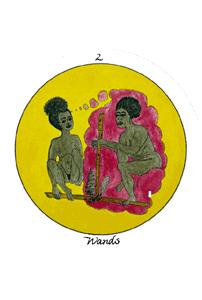
To the left is the Two of Wands from the
Motherpeace Tarot. I bought this deck because it was ROUND and becuase it was multi-racial. Sadly, I really don't like the deck. The artwork doesn't speak to me at all. I personally don't think the artwork is very good. I am also not fond of the symbolism throughout most of the deck. The card backs are gorgeous, but this wasn't my best purchase.
This deck taught me to look at the quality of the artwork in a deck before I buy it. Before this deck, I really didn't know to do that. I bought a deck because of the title, the colors, and the concept. I simply didn't know a thing about art back then... not that I'm highly educated on art now! But you know what I mean. I so dislike this deck that I hardly ever read with it, despite it being wonderfully round and being quite delightful to hold in my hands. I couldn't read with it at all at first, but the longer I have it the easier it is to read with. I still don't like the artwork though.
Regardless, I chose to use this card as an example for the Two of Wands because it's such a non-traditional take on the card. A woman is imagining (or perhaps remembering) what she could be using her wands for. Wands are often seen as being of the fire element. They are also seen as representing entrepreneurs. Invention (of tools to create fire) isn't so far from entrepreneurial sprit.
So, what elements exist in this card that we can use an apply in a tarot reading? This woman is a problem-solver. She's someone who can use what she has available to improve her situation. She can envision ideas and she can implement them.
What if this card were reversed? Or what if you draw it and its more obvious aspects don't speak to you? What is the other side of this card? When I turn this card upside down I am less aware of the woman who is doing the thinking and more conscious of the woman inside the thought bubble. I'm more aware of her foot on the wand and the movement of her hands. When I turn this card upside down, it becomes a card that is less about ideas and invention and more about implementation of ideas and taking action.
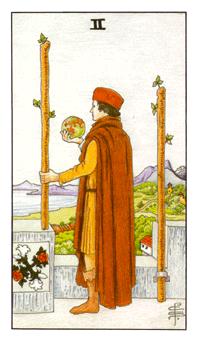
The card to the right is how you usually see the Two of Wands. A man stands atop his castle, he holds a globe of the Earth in one hand. A staff in his other hand represents his power and success, the land around him represents his wealth, yet he wants more. At least that's one way to see it.
Yes, maybe he is holding the globe in his hand and maybe it represents how he feels like he owns the world, maybe he feels he's king of all he surveys. Or, maybe, the man holds the globe as a symbol of what he has not yet accomplished or experienced. Looking at it that way, he's now a man wistfully thinking about land he has yet to conquer.
Funny thing about tarot reading and intuition, you may see this card one way for one person and another way for someone else. It's good to explore every card and understand the multiple meanings one card can have.
Notice also that the wands are sprouting leaves (traditionally wands are alive). Wands are about growth, enthusiasm, and passion. In the Motherpeace deck the woman's wands aren't sprouting anything, but they are certainly being used as tools to create something--fire! And the wands also inspired thought in the woman. When you are reading tarot, remember to pay attention not just to the suit but how a particular suit is being used in the cards.
Let's talk about past and future for a moment. For Westerners, it's common to perceive the future as being to the right and the past being to the left. This shows up in our handwriting and in our body language when we are trying to remember something (our eyes drift to the left). Notice the woman on the Motherpeace card. Yeah, she's looking to her left but from our perspective she's facing the right side of the card--the future. She is thinking about what she is going to do. I see that card as a future oriented card. In the Universal Waite (above) Two of Wands the man looks off to the left side of the card. To me, he is wistful. He is thinking about what should have been or what he wishes for. He has so much, why is he so determined to have more? Something from his past driving him, perhaps? Which way the figures are facing on the cards you draw are something to factor into your readings. More on that later.

Monday, January 8, 2007

Lesson 10, Exercise 2: The Yes or No Spread

I have personally never found this technique very accurate, but it may work very well for you. For me, the tarot has no yes/no answers. But we are all different and our psychic gifts work differently with the tarot. Therefore, just because it doesn't work for me doesn't mean it won't work for you.

The yes/no spread I learned and use most often is a seven card spread. It works like this: You ask the tarot a yes/ no question and draw seven cards from a deck that is shuffled for reversed and upright reading. In other words, there should be cards in the deck that are upright and reversed.

The seven cards are laid out, face side down if you prefer but I have always found this to be a technique used more for effect than practicality. Basically, you count 'em up and if the majority are upright, the answer is yes and if the majority are reversed, the answer is no. However, from here, you do a reading on the situation based on the cards you have drawn.

Card 1. How things started, their source, the beginning
Card 2. What fuels the situation, what perpetuates it
Card 3. A card for clear prespective on the situation, what brings it into balance, what is right/fair here.
Card 4. Who stands to lose or suffer from the outcome
Card 5. What will be gained from the outcome, what will be new or different when it is done/complete/settled/decided upon.
Card 6. What is the ideal outcome, what is most desired in this situation.
Card 7. What should be done to bring about the best overall outcome.

Even if the tarot answers wrong to the yes/no situation, it may still provide some much needed insight through the cards drawn.

The meanings ascribed to the different card positions can be changed as you please, so can the number of cards drawn (although it needs to be an odd number).

However, when you decide to create or change a spread, know clearly in advance (of shuffling and drawing) what the spread is about and what the card positions are going to represent. In order to get the clearest answers possible from the Universe, shouldn't your spread be as clear as possible?

If in doubt as to what meaning to ascribe to the different positions of a spread you are creating, then consult the tarot. Let Source now what spread you are working on and what meanings it suggests you ascribe to the positions. You might get some very good insight that way! Don't be afraid to consult the tarot in designing your tarot spreads. What tool could be better suited for it?

Feel free to practice this spread and send me your results if you want some help interpreting the cards you drew on the situation. Preferably, practice this on a real situation, take plenty of notes, then check back after the even has come to pass so you can make sense of the reading and the cards. How else will you learn if you don't take notes and look back at them after the fact? This is the ideal way to hone your skills. Upcoming elections, races, games, and the like are not a great way to practice your tarot accuracy because you are asking the tarot to tell you about the future, and the future is a constantly changing thing--difficult to predict. No, it's not cheating to try and use the tarot to predict lottery numbers, but if predicting the future were very practical, more of us readers would be quite wealthy.

Better to practice a spread like this on, say, a situation like, "Will the ____ I ordered arrive in the mail today?" It's not exactly a future prediction because your package may already be queued up for delivery to your house the day you draw. You've already ordered it, there's not much chance it won't show--it's only exactly when that's up in the air. There aren't as many factors to interfere with this future, a much clearer answer is likely.


This reminds me of an online Yes/No oracle. It's silly fun.